


Key Takeaways
- AI demand is driving a server CPU surge, leading Intel to plan 10-25% price hikes and a new Nvidia partnership.
- A forecasting error caused severe supply shortages, forcing Intel to cannibalize its PC chip manufacturing.
- Despite the lucrative setup, investors remain cautious due to Intel's history of poor execution and missteps.
The Unexpected Renaissance of the CPU
For the past couple of years, the entire technology world has been hyper-focused on GPUs, the specialized chips driving the artificial intelligence revolution. But a subtle shift is happening right now, and it is breathing new life into the traditional server CPU market.
The catalyst is the rise of "agentic AI." These are AI programs that act autonomously on your behalf, and they do not sleep. Because AI agents submit data requests much faster than human users, overall token demand has increased by 15 times. Furthermore, the specific background tasks these agents perform—like web searches, code execution, and database queries—are actually best handled by CPUs rather than GPUs.
The math behind this shift is staggering. It is estimated that every gigawatt of data center capacity now requires 120 million CPU cores, which is a fourfold increase compared to the 30 million cores required just last year.
The Forecasting Fumble
As the dominant player in the server CPU space, Intel should be taking a victory lap. Instead, they are scrambling.
Intel posted solid numbers for the fourth quarter of 2025, hitting the high end of their guidance with $13.7 billion in revenue. However, their outlook for the first quarter of 2026 took a sudden, weak turn, guiding for only $12.2 billion in revenue.
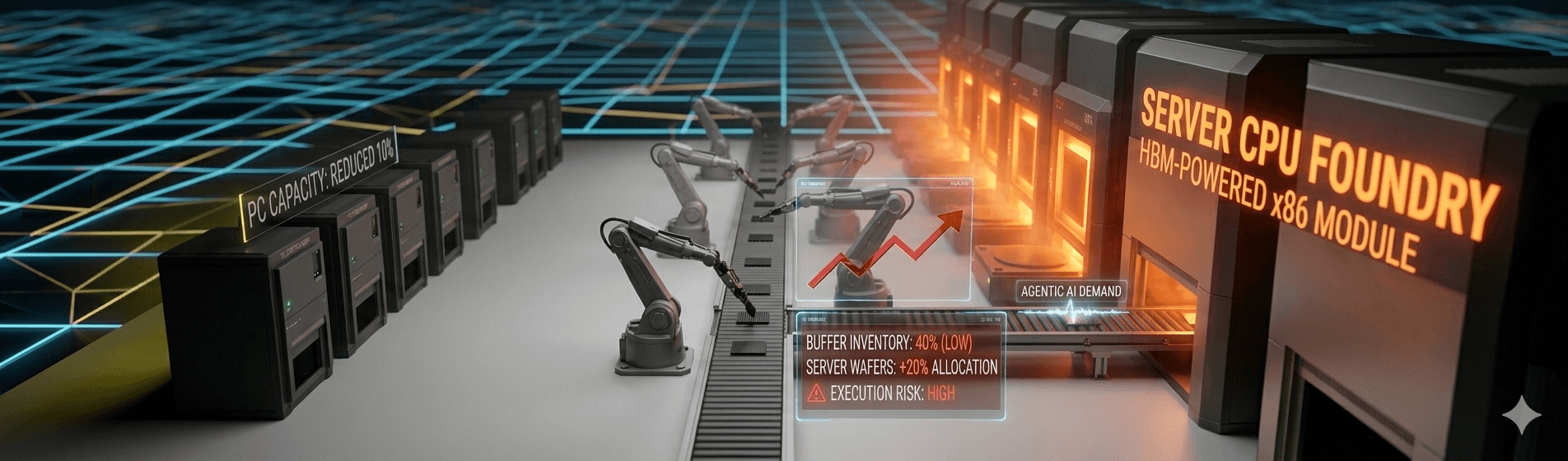
The reason? Management completely misjudged the market. Six months ago, Intel made a forecasting error regarding AI infrastructure demand. Demand from major cloud providers for server CPUs came in far higher than Intel expected, wiping out their buffer inventory. Today, Intel's finished goods inventory is sitting at just 40% of its normal peak levels, leaving the company in a severe, hand-to-mouth supply crisis.
The Fix: Robbing Peter to Pay Paul
To stop the bleeding and capture the high-margin server demand, Intel management is executing a drastic capacity reallocation. They are shifting roughly 10% of their PC chip manufacturing capacity over to the server side.
To understand why this works, it helps to look at the physical size of the chips:
- PC Chips are small: The average PC processor is roughly 120 square millimeters, allowing Intel to slice about 350 working chips out of a single silicon wafer.
- Server Chips are massive: A server CPU can be 500 to 600 square millimeters, meaning a single wafer yields only about 60 chips.
Because Intel's historical PC production volumes are so much larger than its server volumes, diverting just 10% of the PC manufacturing line results in a massive 20% increase in the number of wafers available for server chips. Since server chips are significantly more profitable, this reshuffle should provide a strong boost to the company's bottom line.
The Nvidia Wildcard
Beyond fixing their own supply chain, Intel has secured a highly strategic partnership. While competitors like Arm are trying to push into the data center space, enterprise customers still vastly prefer the traditional x86 architecture that Intel builds because of its software compatibility and single-threaded performance.
Recognizing this, Nvidia partnered with Intel late last year. Intel is now manufacturing customized x86 CPUs specifically for Nvidia, which Nvidia will integrate directly into its advanced AI infrastructure platforms. This allows customers to keep the software ecosystems they are comfortable with while getting maximum AI performance.