


Key Takeaways
- The crucial question for semiconductor investors is whether AI is a temporary surge or a structural shift.
- Projected AI scaling indicates an insatiable demand for data storage and high-speed memory access.
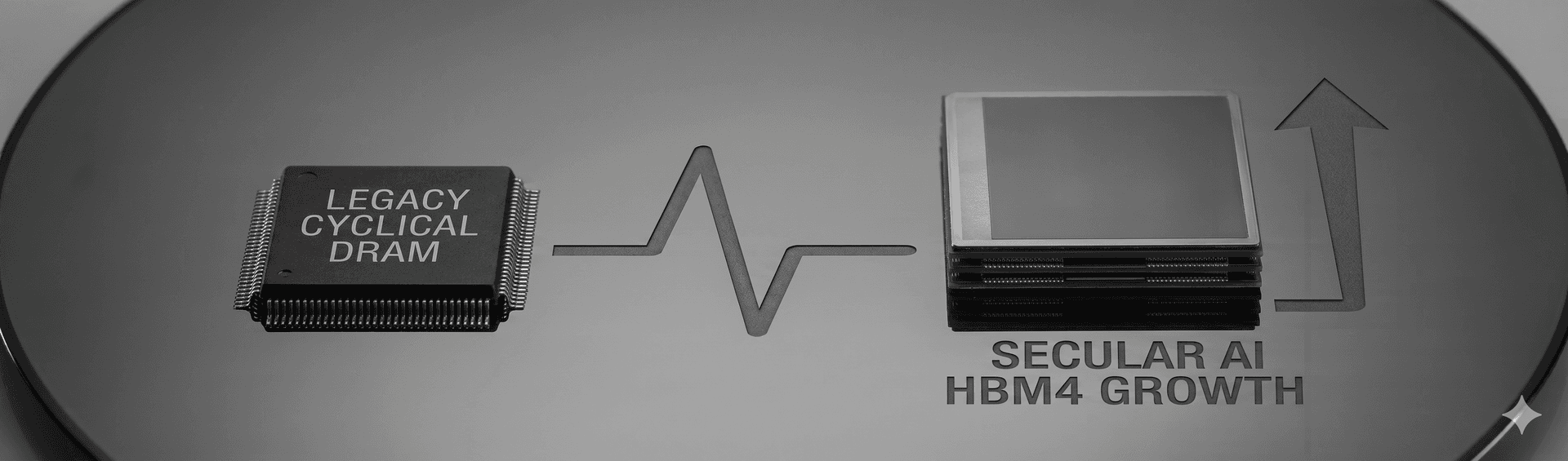
- Persistent AI demand may smooth the memory market's historical boom-and-bust cycles into a resilient runway.
Micron recently reported record-breaking earnings, driven by a massive supply shortage and an unprecedented surge in AI-driven memory demand. While the company expects this strength to continue, the market remains cautious, suffering from historical "memory PTSD". For investors, the key debate is whether we are approaching the peak of a traditional boom-and-bust cycle, or if AI has fundamentally transformed memory into a long-term, secular growth story.
The Numbers Defy History
In the semiconductor industry, memory chips—DRAM and NAND—have historically been viewed as highly cyclical commodities. However, Micron's recent financial results are challenging that traditional narrative.
For the February 2026 quarter, Micron reported earnings per share of $12.20, far exceeding market expectations. More notably, their guidance for the upcoming May quarter projects earnings of $19.15 per share at the midpoint, alongside a staggering gross margin of 81%. This level of profitability is largely driven by a severe supply-demand imbalance that is pushing memory prices substantially higher across the board.
The Ghost of 2018: Memory PTSD
To understand the market's current hesitation despite these blowout numbers, we have to look back at the industry's notorious boom-and-bust history. Veteran investors often suffer from what analysts call "memory PTSD".
During the last major memory upcycle in August 2018, Micron's gross margins reached a then-record peak of 61.6%. What followed was a classic cyclical fade: hardware makers overbuilt factories, oversupply flooded the market just as demand normalized, and memory prices crashed. In 2018, this dynamic caused Micron's stock to plunge by nearly 54% as the cycle turned.
Today, with Micron guiding for unprecedented gross margins of 81%, skeptics worry that we are simply nearing a much higher ceiling before an inevitable drop. At current levels, the stock trades at just 5 to 6 times next year's earnings estimates. This historically low multiple suggests the market is already pricing in a cyclical peak and assigning little credit to the company's future earning power.
The Case for a Secular Shift: AI Eats the Market
- Data Center Dominance: Data center demand for DRAM and NAND is projected to account for more than 50% of the total industry market size for the first time in 2026.
- Next-Gen Hardware: Micron has already commenced volume shipments of its next-generation 12-high HBM4 (High Bandwidth Memory), securing allocation in advanced AI systems.
- The Edge AI Boom: Demand is expanding beyond data centers into consumer devices.
- Upgraded Specs: AI-enabled PCs now require significantly higher memory, often 32GB or more.
The Supply Wall
- New technology nodes are yielding fewer incremental memory gains.
- HBM production is complex and limits overall DRAM output.
- New capacity expansion will not come online meaningfully until 2028.
- Micron is shifting toward long-term customer agreements to stabilize demand and pricing.